
Frequently asked questions
What is the difference between a MOU and a separation agreement?
A Memorandum of Understanding (MOU) is a written summary of the terms reached in mediation. It is not a legal agreement and is used to support legal review and next steps.
A separation agreement is a formal domestic contract prepared in legal form, intended to be signed, witnessed, and relied upon as an enforceable agreement.
Is a separation agreement legally binding in Ontario?
Under Ontario law, a separation agreement must generally be in writing, signed by the parties, and witnessed to be enforceable. Courts may set aside an agreement in certain circumstances, such as lack of disclosure, unfair pressure, or misunderstanding of rights.
Do we need a lawyer or Independent Legal Advice (ILA)?
Independent Legal Advice (ILA) is strongly recommended before signing a separation agreement. While parties may choose how they proceed, legal advice helps ensure informed consent, proper disclosure, and long-term reliability of the agreement.
Can a mediated agreement be filed with the court?
Yes certain separation agreements or consent orders may be filed with the court for enforcement purposes, particularly where support obligations are involved. Clearpoint can explain the general process, while encouraging parties to seek legal advice for their specific situation.
Can we submit a mediated agreement to court without lawyers?
Parties may choose how they proceed. Courts closely examine agreements for fairness, disclosure, and understanding, particularly where one or both parties were unrepresented.
What issues can be included in a mediated separation agreement?
A mediated separation agreement may address parenting arrangements, child support, spousal support, property division, debt allocation, and other separation-related matters, depending on the scope of mediation and the parties’ circumstances.
How does mediation work if lawyers are involved?
When parties are represented, mediation may proceed alongside legal counsel. Lawyers may attend mediation sessions or advise clients outside of mediation, while Clearpoint remains focused on facilitating neutral, settlement-oriented discussions.
The Clearpoint documentation pathway
Most Ontario mediation models follow a two-step documentation pathway: the mediator prepares a settlement summary, and the parties obtain legal advice and finalize a separation agreement. Ontario Association for Family Mediation+2Separation Pathways+2
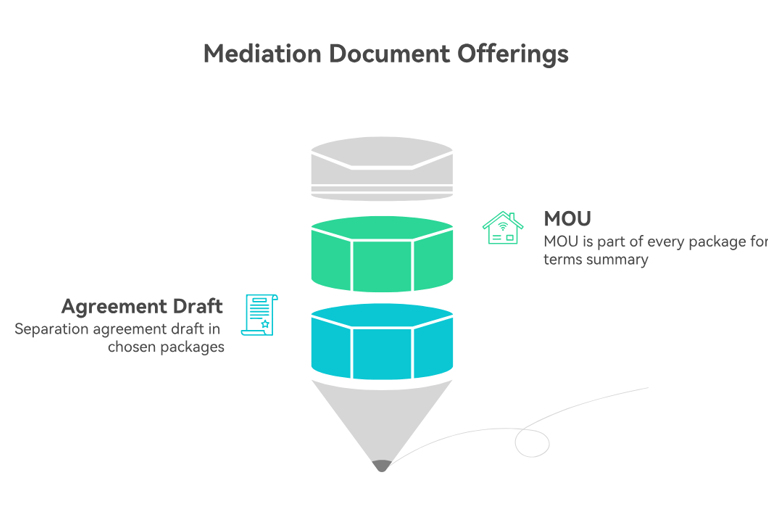
1) Memorandum of Understanding (MOU) — included in all packages
An MOU is a clear written summary of the terms reached in mediation. It is intended to support legal review and next steps. Many Ontario mediation standards explicitly contemplate that clients take the MOU to their own lawyers for independent legal advice, after which a formal separation agreement is drafted. Ontario Association for Family Mediation+1
2) Separation Agreement Draft — included in select packages
In select Clearpoint packages, a mediated separation agreement draft may be prepared to reflect the mediated terms in a more formal structure. This draft is prepared for independent legal review and finalization and does not replace legal advice.

Contact
Reach out for support and guidance
Email:
Phone
info@clearpointmediation.com
519-540-4331