
FAQ: Pensions & Business Assets in Separation
Are pensions considered family property in Ontario?
For married spouses, pensions accumulated during the marriage are generally considered part of Net Family Property under the Family Law Act. The value attributed to the pension depends on statutory valuation rules and the period of the marriage.
Do pensions have to be divided directly?
Not always. Some pensions can be divided at source, while others are addressed through equalization payments using their calculated value. The approach depends on the type of pension and the options available under Ontario regulations.
How are pensions valued in mediation?
Pensions are valued using standardized Ontario methods. During mediation, the focus is on understanding the value, timing implications, and how pension division fits within the broader financial settlement.
What if one spouse owns a business or professional practice?
Business and professional interests may form part of family property, depending on ownership structure and when they were acquired. Mediation helps clarify how business assets, income, and liabilities are considered without disrupting ongoing operations.
Does business value affect support discussions?
Yes. Business income and retained earnings may be relevant when discussing child or spousal support. These issues are explored carefully to ensure financial decisions are informed and balanced.
Can mediation handle complex financial situations?
Yes. Mediation can accommodate complex assets, including pensions, businesses, and investments, by incorporating structured financial clarification and, when necessary, third-party valuations.
Division of Assets
Clear, fair financial outcomes—without unnecessary conflict
Financial issues are one of the most common barriers to resolution during separation and divorce. Property division often involves complex calculations, emotional strain, and uncertainty about what is fair or required under Ontario law.
At Clearpoint, asset division is supported by a dedicated Family Finance Consultant (MBA) who works alongside the mediation process to help families understand their full financial picture and move toward informed, balanced settlements.
Our role is to bring clarity, structure, and transparency to financial decision-making—so negotiations can focus on resolution rather than confusion or mistrust.
How Division of Assets Works in Ontario
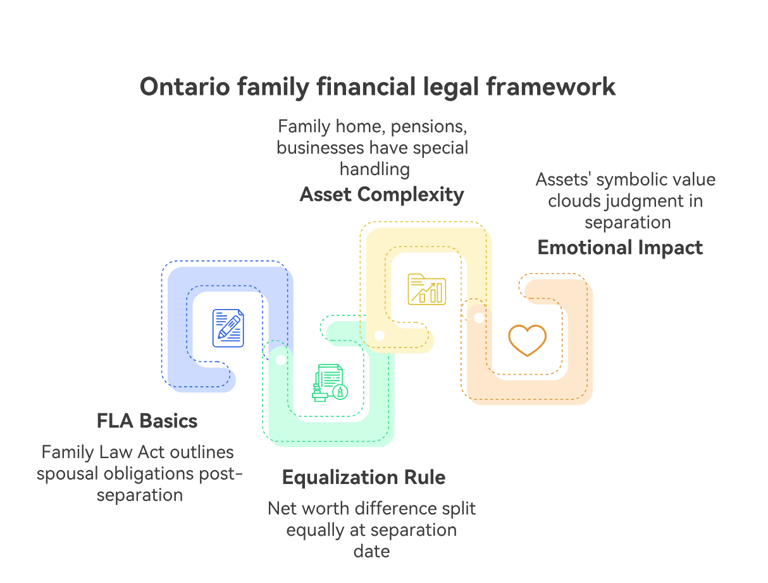
In Ontario, property division is governed by the Family Law Act (FLA) for married spouses. Under the Act:
• Each spouse calculates their Net Family Property
• Net Family Property represents the value of assets accumulated during the marriage, minus debts and permitted exclusions
• If one spouse’s net family property is higher, an equalization payment may be owed to the other spouse
• Both assets and liabilities are included in the calculation
Common-law spouses do not have automatic property equalization rights under the Family Law Act and may rely on different legal principles. This distinction is carefully explained during the mediation process so participants understand their options and limitations.
What May Be Considered Family Property
Depending on your circumstances, family property may include:
• The matrimonial home
• Bank accounts and savings
• Investments (such as stocks, bonds, or mutual funds)
• Pensions and retirement savings
• Vehicles
• Businesses or professional practices
• Valuable personal property (such as art or jewelry)
Certain assets may be excluded, such as property owned before marriage or specific gifts or inheritances, provided they meet the requirements set out in Ontario law.
Our Approach: Structured, Transparent, and Informed
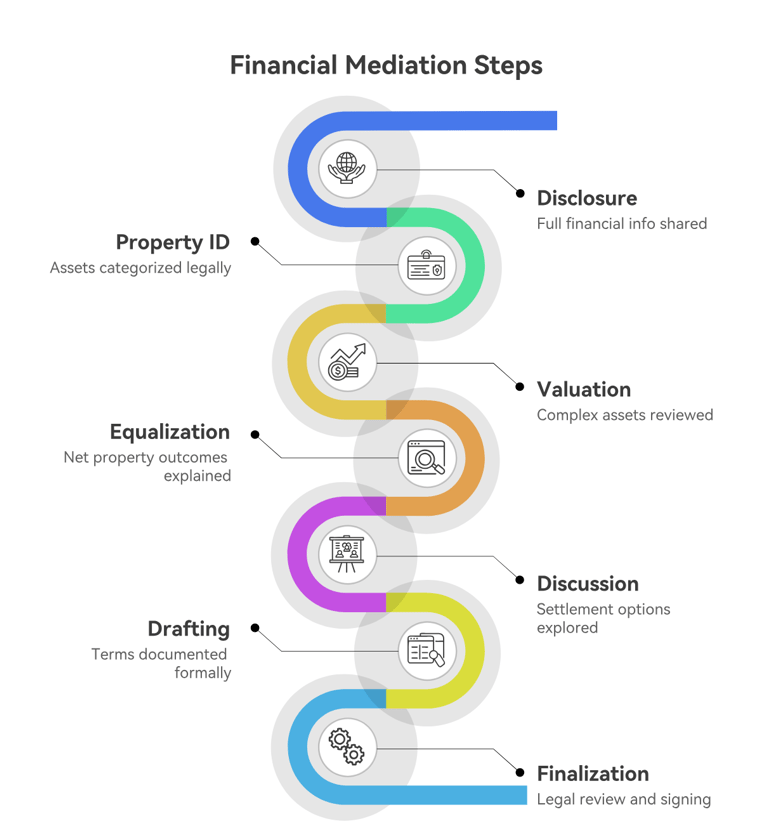
Asset division is supported by our Family Finance Consultant (MBA) using a structured, technology-supported process designed to reduce error, delay, and conflict.
Our approach is:
• Comprehensive
All relevant assets and liabilities are identified and reviewed to ensure a complete financial picture.
• Transparent
Clear calculations and summaries help participants understand how numbers are derived and what options are available.
• Efficient
Technology-supported analysis reduces delays and minimizes misunderstandings that often lead to impasse.
• Balanced
Information is presented neutrally to support informed, voluntary decision-making within mediation.
This process supports meaningful discussion and helps participants move toward workable, durable financial arrangements.
Why Use a Family Finance Consultant (MBA) in Mediation?
• Financial analysis grounded in Ontario family law principles
• Neutral, non-advisory financial clarification
• Support for complex financial situations, including pensions and businesses
• Clear financial summaries to support negotiation and legal review
• Reduced reliance on adversarial financial experts
Whether your finances are straightforward or complex, informed financial clarity supports better decisions and more sustainable agreements.
Important Note
Financial information provided during mediation is for informational and settlement-support purposes only.
Clearpoint mediators and consultants do not provide legal advice. Participants are encouraged to obtain independent legal advice before finalizing any agreement.
It’s essential not to let money matters overshadow your chance for a fresh start. By proactively addressing the financial implications, you can regain control and alleviate anxiety. Focus on planning and seeking support to navigate this transition smoothly.
Book a confidential consultation

Contact
Reach out for support and guidance
Email:
Phone
info@clearpointmediation.com
519-540-4331