
Common-Law in Ontario
Frequently Asked Questions
What does “common-law” mean in Ontario family law?
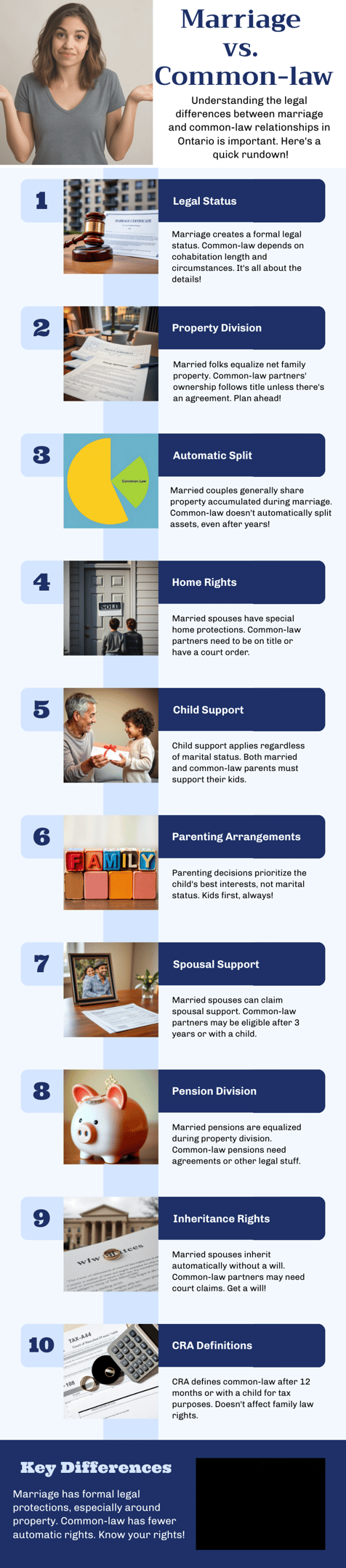
In Ontario, “common-law” generally means you are not legally married but have lived together in a conjugal relationship long enough to be treated as “spouses” for certain purposes, primarily spousal support.
Under Ontario’s Family Law Act, unmarried partners may be considered spouses for support if they have lived together continuously for at least three years, or if they are in a relationship of some permanence and have a child together.
https://www.ontario.ca/page/spousal-support
Important note: “Common-law” can mean different things depending on context. The definition used for Ontario family law is not the same as the definition used by the Canada Revenue Agency or immigration authorities.
Are common-law and married couples treated the same when they separate in Ontario?
No. The most significant legal difference involves property division.
Married spouses are subject to a statutory property-sharing regime called equalization of Net Family Property under the Family Law Act.
Common-law partners generally do not have automatic property equalization rights. Property usually follows legal ownership unless there is a domestic contract or a successful court claim such as unjust enrichment or constructive trust.
https://www.ontario.ca/page/dividing-property-when-marriage-or-common-law-relationship-ends
If we are common-law, do we automatically split everything 50/50?
Usually, no.
Ontario government guidance is clear that automatic equal division of property applies to married spouses, not to common-law partners.
In practical terms, if a home, bank account, investment, or vehicle is in one partner’s name, the other partner does not automatically have a right to half unless there is an agreement or a legal claim established.
https://www.ontario.ca/page/dividing-property-when-marriage-or-common-law-relationship-ends
Do common-law partners have “matrimonial home” rights?
No. This is a major difference between marriage and common-law relationships.
Ontario’s matrimonial home protections are tied specifically to marriage. Married spouses may have possessory rights to the matrimonial home regardless of title.
Common-law partners generally do not have the same automatic right to remain in the home unless they are on title or lease, or obtain a court order based on other legal grounds.
https://www.ontario.ca/page/dividing-property-when-marriage-or-common-law-relationship-ends
If we have children, does common-law status affect parenting rights?
No. Parenting rights and responsibilities are not reduced because parents were never married.
In Ontario, parenting matters are decided based on the best interests of the child, not the parents’ marital status. Many Ontario cases rely on the Children’s Law Reform Act, which governs decision-making responsibility, parenting time, and contact.
https://www.ontario.ca/laws/statute/90c12
Do common-law parents still have to pay child support?
Yes. Child support is the legal right of the child and applies regardless of whether parents were married.
Ontario uses Child Support Guidelines for many cases, and federal guidelines may apply depending on the legal framework. The obligation to support children exists regardless of marital status.
https://www.ontario.ca/page/arranging-child-support
https://www.justice.gc.ca/eng/fl-df/child-enfant/index.html
Can common-law partners claim spousal support in Ontario?
Yes, in some circumstances.
If a common-law partner meets Ontario’s definition of “spouse” for support purposes (generally three years of cohabitation, or a relationship of some permanence with a child), they may be eligible to claim spousal support under the Family Law Act.
Spousal support is not automatic. Entitlement, amount, and duration depend on the facts of the relationship and separation.
https://www.ontario.ca/page/spousal-support
Do common-law partners inherit automatically if there is no will?
Generally, no.
In Ontario, common-law partners do not automatically inherit under intestacy rules when there is no will. Married spouses have statutory inheritance rights; common-law partners typically do not and may need to rely on court-based claims such as dependant support.
https://www.ontario.ca/page/what-do-if-someone-dies-without-will
This makes wills and beneficiary designations especially important for common-law couples.
What about pensions for common-law partners?
Ontario’s Financial Services Regulatory Authority explains that the Family Law Act does not require common-law partners to equalize Net Family Property, and pension division does not automatically apply in the same way as it does for married spouses.
Pensions may still be addressed by agreement or other legal processes.
https://www.fsrao.ca/consumers/pensions
Does CRA treat common-law differently than Ontario family law?
Yes.
CRA uses its own definition for tax and benefit purposes. CRA generally considers couples common-law after 12 continuous months of living together, or sooner if they share a child.
As a result, you may be common-law for tax and benefit purposes before you are considered spouses for spousal support under Ontario family law.
https://www.canada.ca/en/revenue-agency/services/tax/individuals/life-events/what-your-marital-status.html
Common Mistakes Common-Law Couples Make in Ontario
1) Assuming common-law means “the same as married”
One of the most common misconceptions is that common-law partners automatically share property the same way married spouses do. In Ontario, equalization of Net Family Property applies only to married spouses. Common-law partners do not have automatic property division rights.
2) Believing length of relationship alone creates property rights
Living together for many years does not, by itself, create a right to an equal split of property. Ownership, contributions, and legal principles such as unjust enrichment may be relevant, but outcomes are fact-specific.
3) Confusing CRA rules with family law rules
People often assume their CRA common-law status determines their rights under Ontario family law. These are separate systems with different definitions and consequences. Being common-law for taxes does not automatically create property rights under family law.
4) Not updating CRA after separation
Failing to update CRA after a common-law separation can affect benefits such as the Canada Child Benefit, GST/HST credits, and other income-tested programs. Delayed updates can result in overpayments and future reassessments.
5) Assuming both partners have equal rights to the home
If only one partner is on title or the lease, the other does not automatically have a right to remain in the home after separation. This often comes as a surprise and can create urgency and conflict if not addressed early.
6) Overlooking spousal support eligibility
Some common-law partners assume they are not eligible for spousal support because they were not married. In reality, spousal support may be available depending on the length of the relationship or whether there are children.
7) Ignoring pensions and business interests
Common-law partners sometimes overlook pensions or business assets because they assume these are “off limits.” While the treatment differs from married couples, these assets may still be relevant to support discussions or financial claims.
8) Waiting too long to seek clarity
Delaying financial and legal clarification often increases conflict, stress, and cost. Early understanding of rights, limitations, and options supports more informed and constructive decision-making.
Important Information
This information is provided for general educational purposes only and does not constitute legal or tax advice. Mediation is a voluntary, confidential, and impartial process. Participants are encouraged to obtain independent legal and/or tax advice for their specific circumstances.

Contact
Reach out for support and guidance
Email:
Phone
info@clearpointmediation.com
519-540-4331